
WW2 cap badge identification
A cap badge names his regiment, if you know how to read it. Start with the scroll, then the symbols, then the crown.
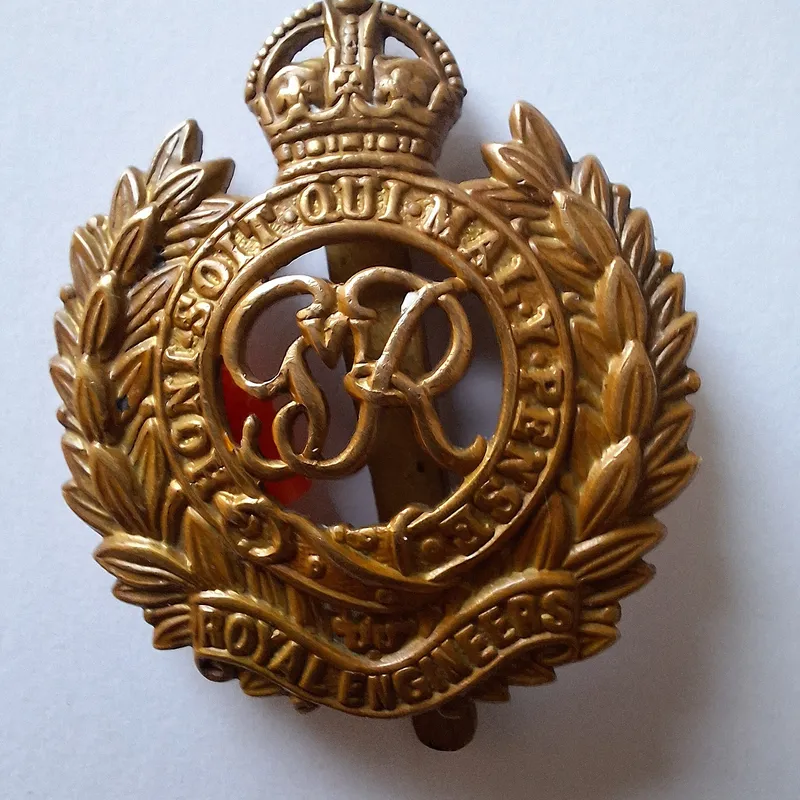

WW2 cap badge identification takes three checks. Read the title scroll, which usually names the regiment or corps. Decode the main symbol. Then check the crown: a King’s Crown fits 1902–1953, so it covers the war. Once you know the regiment, confirm it with his records.
Key facts
- First clue
- The title scroll: the regiment's name
- Dating
- King's (Tudor) Crown 1902–1953; Queen's Crown after 1953
- Sharper dating
- A royal cypher names the monarch
- Wartime plastic
- 'Economy' badges to save metal, contracts February 1942 to June 1946
- Proof
- A badge is a clue. His service record is proof
From the National Army Museum, checked 31 October 2026.
Most badges can be identified in minutes. Here is how.
Why the cap badge matters
Soldiers wear a badge on their headdress to show the regiment or corps they belong to. The National Army Museum (NAM) says many badges carry symbols important to the unit: a link to a monarch, the regiment’s city or county, or a famous battle honour.
Since the mid-1700s, badge design has been controlled by the Army’s high command. So badges follow rules. That makes them readable.
Step 1: Read the title scroll
The NAM calls the regiment’s name, or sometimes its number, the most distinguishing feature of a headdress badge. Look at the ribbon or scroll, usually along the bottom.
It may show:
- the full name, for example “Oxford & Bucks L I”
- a county or city
- a motto instead of a name
A motto can be searched. Type it into a search engine with “regiment” and you will usually have an answer.
Step 2: Decode the symbol
No readable scroll? Look at the main design. The NAM explains what many common symbols mean.
| Symbol | What it suggests |
|---|---|
| Stringed bugle horn | Light infantry or rifle regiment |
| Flaming grenade | Fusilier regiment or Grenadier Guards |
| Rifle, shovel and pick | Pioneer Corps |
| Lances | Lancer regiment |
| Saltire, thistle, rampant lion or St Andrew | Scottish regiment |
| Harp or shamrock | Irish origins |
| Castle and key | Great Siege of Gibraltar (1779–83) honour |
| Sphinx | Egyptian campaign of 1801 honour |
| Tiger or elephant | Service in the Indian subcontinent |
| St George killing a dragon | Northumberland Fusiliers |
| Stag with “Cuidich ‘n Righ” | Seaforth Highlanders |
| White or red rose | Yorkshire or Lancashire ties |
| Star of the Garter, St Andrew or St Patrick | Coldstream, Scots or Irish Guards |
Some symbols are shared. A bugle horn alone won’t tell you which light infantry regiment. Combine it with the scroll, the shape and the crown.
A note on the sphinx
The NAM records that soldiers of the 28th Foot, and its successor the Gloucestershire Regiment, had the unique distinction of wearing the sphinx at the back of their headdress too. It commemorates their back-to-back stand at the Battle of Alexandria. If you find a small sphinx badge with the family’s WW2 things, that is a strong clue.
Step 3: Date the badge by its crown
Crowns change with the reign. The NAM gives three main types:
- Victorian Crown: 1837–1902
- King’s Crown (also called the Tudor Crown): 1902–1953
- Queen’s Crown: after 1953
A WW2 badge should carry the King’s Crown. A Queen’s Crown means the badge is post-war. It may still be his, if he served on, but it isn’t wartime.
Royal cyphers date it more closely
The NAM notes that royal cyphers are less common than crowns but allow more accurate dating, because each belongs to one monarch. The Royal Engineers badge in our photo carries the cypher of George VI, who reigned through the whole war.
Plastic WW2 cap badges
Found a badge that looks like brown or dark plastic? It may be a wartime economy badge.
The NAM describes plastic badges introduced to economise on brass and other metals. It says contracts ran from February 1942 to June 1946. They were made in several colours, including silver, brass, chocolate brown, mid brown, and dark blue for the Royal Marines.
So a plastic badge fits the war years well. Handle it gently. Plastic can crack.
Sweetheart brooches
Not every badge was worn by him. Men gave small, often jewelled copies of their regimental badge to wives, sisters and girlfriends.
The NAM holds examples. One, for The Buffs (Royal East Kent Regiment), is a mother-of-pearl disc with the regimental badge and a blue enamel scroll. A private gave it to his sister. Another, for the Oxford and Buckinghamshire Light Infantry, is a silver bugle horn above a blue enamel scroll.
If you find a brooch in Grandma’s jewellery box, it tells you the same thing as a cap badge: the unit he was in, or wanted her to remember.
From badge to records
A badge is a clue, not proof. Men changed units. Brothers swapped souvenirs. Families picked up badges after the war.
To confirm it:
- Look for a photograph of him in uniform. Compare the badge on his cap.
- Check letters for a return address or unit name. Our guide to reading WW2 letters helps.
- Order his service record. See WW2 Army service records.
- Use the regiment to narrow down the battalion. See how to find which battalion grandad served in.
Medals with the badge? Our guide to identifying WW2 medals will tell you where he served.
Badges in photographs
Zoom in on any photo of him in uniform. Even blurred, the outline helps. A tall plume, a round wreath, a star, a grenade: each narrows it down.
Compare the outline with the table above. Then look for a scroll. Collar badges, where visible, can confirm the reading.
Looking after a cap badge
We’d advise against polishing. It can wear away fine detail and the original finish. Keep the badge dry, in a small acid-free bag or box, labelled with what you know and where it was found.
Record where it came from. “Found in Grandad’s tin with his pay book” is worth writing down. Our guide to preserving WW2 letters and documents covers storage.
FAQ: identifying WW2 cap badges
How do I identify a WW2 cap badge?
Read the title scroll first; it usually names the regiment or corps. If there is no scroll, decode the main symbol and check the crown. A King's Crown fits 1902–1953, which covers the Second World War.
What crown is on a WW2 cap badge?
The King's Crown, also called the Tudor Crown, used from 1902 to 1953. A Queen's Crown dates a badge to after 1953, so it is not wartime.
Why is my WW2 cap badge made of plastic?
To save brass and other metals. The National Army Museum says contracts for these 'economy' badges ran from February 1942 to June 1946, in several colours.
Does a cap badge prove which regiment he served in?
No. Families kept badges for many reasons, and men moved between units. Treat it as a lead, then confirm it with his service record.
What is a sweetheart brooch?
A small, often jewelled, version of a regimental badge, given by a serving man to a wife, sister or girlfriend. It points to his unit just as a cap badge does.
Can a cap badge tell me his battalion?
Not on its own. A cap badge points to a regiment or corps. His service record is the best source for the battalion, and our battalion guide shows how to find it.
Sources
Checked 31 October 2026.