
How to identify WW2 medals
Bronze six-pointed star, round cupronickel medal, or silver cross? Start with the shape.
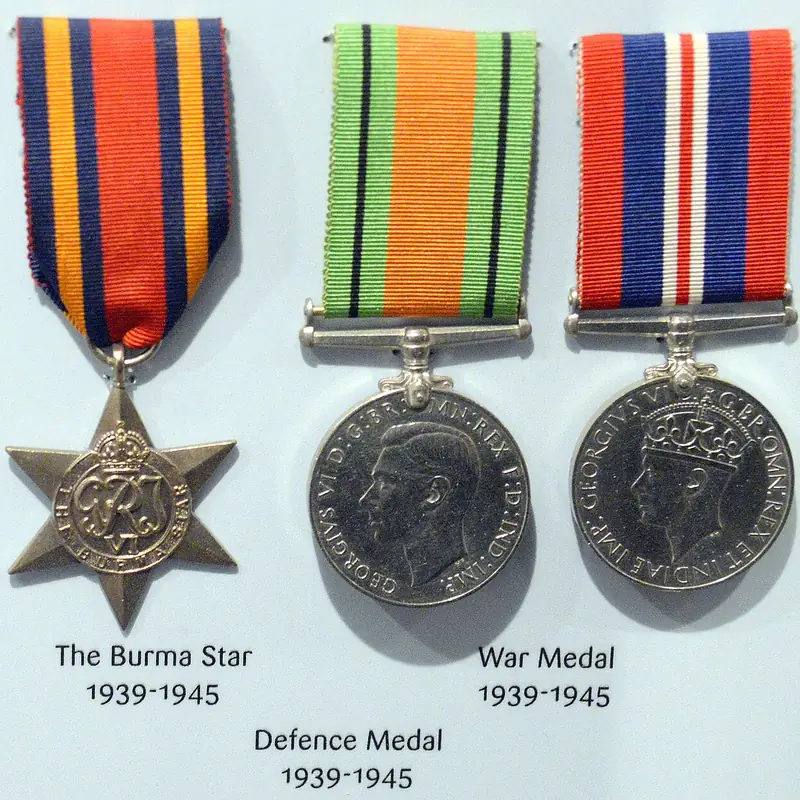

To identify WW2 medals, start with the shape. A bronze six-pointed star is a campaign star: its name is written around the King George VI cypher in the centre. A round cupronickel medal is the Defence Medal or the War Medal. A silver or enamelled cross is usually a gallantry or service award. Then check the ribbon, using our WW2 medal ribbon chart.
Key facts
- Stars
- Bronze, six-pointed, King George VI cypher in the centre, the star's name around it
- Round medals
- Defence Medal and War Medal, both cupronickel
- Names
- Campaign stars and medals were issued unnamed
- Limit
- No more than five stars to one person (six with the Arctic Star)
- Oak leaf
- A bronze oak leaf on the War Medal ribbon means a Mention in Despatches or King's Commendation
Based on GOV.UK medal guidance (current and archived) and the London Gazette, checked 31 October 2026.
Most family groups are a mix of stars and round medals. Here is the detail.
Step 1: Is it a star, a round medal or a cross?
| Shape | What it is | How to tell which |
|---|---|---|
| Bronze six-pointed star | Campaign star | Name around the centre, eg “The Africa Star” |
| Round, cupronickel, crowned King | War Medal 1939-1945 | Lion on a two-headed dragon on the back |
| Round, cupronickel, uncrowned King | Defence Medal | Crown on an oak tree, two lions, on the back |
| Silver or enamelled cross | Gallantry or order | See step 4 |
| Round silver medal | Possibly a gallantry or long service medal | Read the inscription |
| {: .records-table } |
GOV.UK describes eight stars in its older guidance, and nine today. The ninth is the Arctic Star, added later.
Step 2: Which WW2 campaign star is it?
Read the name on the star itself. The nine are:
- 1939 to 1945 Star. Operational service overseas, 3 September 1939 to 8 May 1945 (2 September 1945 in the Far East). GOV.UK notes it is sometimes wrongly called the “Victory medal”.
- Atlantic Star. Atlantic and home waters. Awarded only after the 1939 to 1945 Star had been qualified for.
- Arctic Star. Service of any length north of the Arctic Circle, 3 September 1939 to 8 May 1945. It commemorates the Arctic convoys.
- Air Crew Europe Star. Almost exclusively RAF aircrew, flying over Europe from UK bases, up to 5 June 1944.
- Africa Star. North Africa, Malta or Egypt, 10 June 1940 to 12 May 1943.
- Pacific Star. Malaya, Singapore, China, Hong Kong or Sumatra, and the Pacific, 8 December 1941 to 2 September 1945.
- Burma Star. Burma, 11 December 1941 to 2 September 1945, plus some other areas.
- Italy Star. Sicily or Italy, 11 July 1943 to 8 May 1945, plus Yugoslavia, Greece, Corsica and Sardinia at set dates.
- France and Germany Star. France, Belgium, Luxembourg, the Netherlands or Germany, 6 June 1944 to 8 May 1945.
A group tells a story. For example, an Africa Star, Italy Star and France and Germany Star together suggest a soldier who followed the war from the desert to Germany. Confirm it with his service record.
Why can’t he have more stars?
The rules capped it. GOV.UK says no more than five stars could be awarded to one person. If he qualified for both the Pacific and Burma Stars, he got the first earned, plus a clasp naming the second. The same applies across the Atlantic, Air Crew Europe and France and Germany Stars: first star, plus one clasp, and no third.
The 1939 to 1945 Star, Africa Star and Italy Star could be awarded regardless. The Arctic Star now allows a sixth star to be worn.
Step 3: The Defence Medal and War Medal
Both are round and made of cupronickel.
The War Medal 1939-1945. Crowned head of King George VI on the front. On the back, a lion standing on a two-headed dragon, with the dates 1939 and 1945. It went to full-time members of the armed forces with at least 28 days’ service between 3 September 1939 and 2 September 1945. It came in addition to any stars.
The Defence Medal. Uncrowned head of King George VI on the front. On the back, the Royal Crown on an oak tree, flanked by two lions, with the dates. It was for non-operational service: headquarters, training bases, airfields, the Home Guard, and some service overseas. See our Home Guard records guide.
Step 4: Crosses and gallantry awards
Gallantry awards are rarer. Here is how GOV.UK describes three common ones:
- Military Cross (MC). An ornamental silver cross, straight arms ending in broad finials with Imperial Crowns, Royal Cypher in the centre. Ribbon: purple centre stripe between white.
- Distinguished Service Cross (DSC). A silver cross with rounded ends, crowned Royal Cypher in the centre. From 1940 the year was engraved on the lower arm. Ribbon: white centre between dark blue.
- Distinguished Flying Cross (DFC). A silver cross flory, its arms ending in bombs and a rose, with propellers and wings. Ribbon: narrow diagonal white and purple stripes.
A cross means you should search the London Gazette. Our guide to WW2 gallantry awards and the London Gazette shows how.
Step 5: Clasps, oak leaves and emblems
Small additions carry big meaning.
- A clasp on a star’s ribbon names a second star he qualified for, or a special clasp such as “Battle of Britain” or “Bomber Command” on the 1939 to 1945 Star.
- A bronze oak leaf on the War Medal ribbon means a Mention in Despatches, a King’s Commendation for brave conduct or a King’s Commendation for valuable service in the air, for Second World War service. The London Gazette set this out in 1951.
- No War Medal but an oak leaf? The Gazette says the emblem was then worn directly on the coat, after any ribbons.
Are the medals named?
No. GOV.UK says WW2 campaign stars and medals were issued unnamed, under criteria finalised in 1948. So nothing on a star proves who earned it.
To link medals to a man:
- keep the box, slip or letter they came in
- check his service record for medal entries
- check the WW2 Army medal application cards (C.S. 20), which The National Archives says are searchable on Forces War Records (charges apply)
Gallantry awards are a different matter; GOV.UK says the George Cross, for example, bears the recipient’s rank and name on the back.
Put them in the right order
Medals are worn in a set order. The 2019 Order of Wear, published in the London Gazette, lists the WW2 group as: 1939-1945 Star, Atlantic Star, Arctic Star, Air Crew Europe Star, Africa Star, Pacific Star, Burma Star, Italy Star, France and Germany Star, Defence Medal, then War Medal. Our ribbon chart has the colours.
Something missing?
Many men never claimed their medals. Next of kin can still apply. See how to claim WW2 medals. Think there may be a gallantry award? See WW2 gallantry awards and the London Gazette.
FAQ: Identifying WW2 medals
How do I identify a WW2 campaign star?
Read it. Every WW2 campaign star is a bronze six-pointed star with the King George VI cypher in the centre and the name of the star around it. The ribbon also differs for each star.
Why is there no name on my grandad's WW2 medals?
Because they were issued unnamed. GOV.UK says that when the criteria were finalised in 1948, the WW2 campaign medals were issued unnamed. The box or covering slip they came in may help link them to him.
What is the WW2 medal with a lion on it?
The War Medal 1939-1945. GOV.UK describes the reverse as a lion standing on a two-headed dragon, with the dates 1939 and 1945 above.
What does a bronze oak leaf on a WW2 ribbon mean?
On the War Medal ribbon, a single bronze oak leaf means a Mention in Despatches, a King's Commendation for brave conduct, or a King's Commendation for valuable service in the air, for Second World War service.
How many WW2 medals could one person get?
There is no fixed number of medals, but no more than five stars could be awarded to one person. GOV.UK says the Arctic Star, introduced later, means a sixth star can now be worn.
Sources
Checked 31 October 2026.
- GOV.UK: Medals: campaigns, descriptions and eligibility
- GOV.UK: Medals, campaigns, descriptions and eligibility (archived 2015)
- The London Gazette, supplement 39294, 27 July 1951: Note on Mentions in Despatches
- The London Gazette, issue 62529, 11 January 2019: Order of Wear
- The National Archives: British Army soldiers in service after 1918