
- Home
- Service Records
- WW2 Army service records
WW2 Army service records: how to get one and read it
Where grandad's record is now, what it costs, which option to pick, and how to decode the cramped handwriting once it arrives.
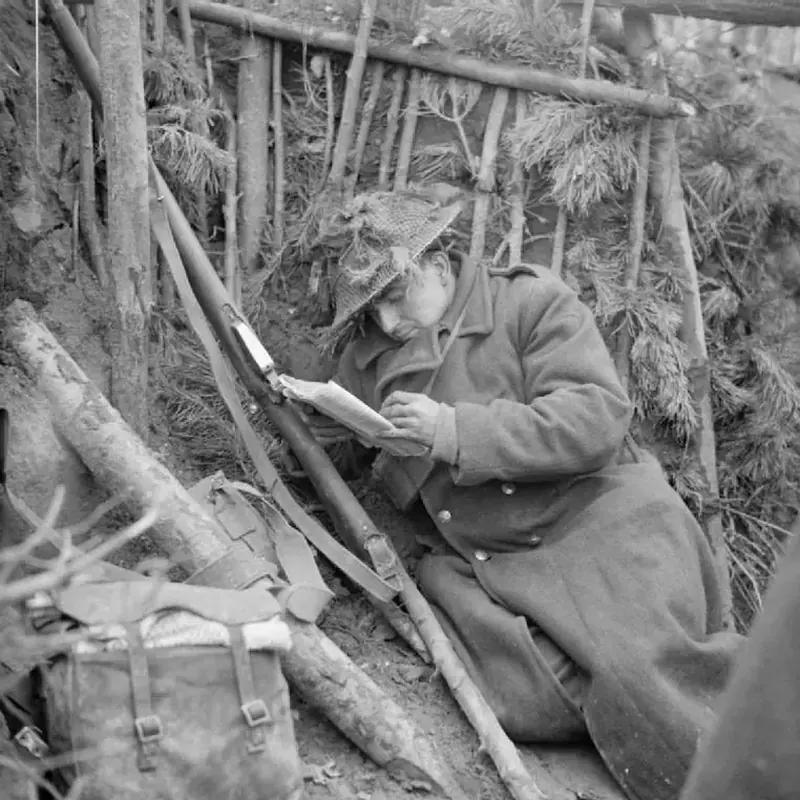

WW2 Army service records for soldiers born before 1940 are now held by The National Archives at Kew, not the Ministry of Defence. Order the Standard copy for £42.25. It arrives as a colour PDF, normally within 30 working days. You need his full name and date of birth. A service number helps more than anything else. Expect to supply proof of death.
Key facts
- Who holds it
- The National Archives, Kew, for soldiers born before 1 January 1940
- Standard copy
- £42.25 as a PDF, £47.16 on paper
- Full record check
- £48.87, plus £1.04 per page released
- Waiting time
- Within 30 working days for Standard
- You need
- Full name, date of birth, service number if known, proof of death
Fees in force since 2 February 2026. Checked against The National Archives on 30 October 2026.
That is the short answer. Below: how to find the record, which version to buy, and how to read it once it lands in your inbox.
Where are WW2 Army service records kept now?
At Kew. Since February 2021 the MOD has transferred the records of British Army soldiers (non-officers) born before 1 January 1940 to The National Archives. GOV.UK confirms the MOD no longer holds them. The full transfer, around 9.3 million service records, is due to finish in 2027.
So for most grandads the answer is simple: apply to The National Archives. The exceptions:
- Born on or after 1 January 1940. Apply to the MOD through GOV.UK.
- Royal Navy. Navy records are not moving to Kew until 2027. Ask the MOD for now.
- Scots Guards. The regiment keeps its own records. Contact its regimental archives.
- Officers. The cheap Standard service does not cover British Army commissioned officers. Use the Full record check.
What do you need before you request a WW2 service record?
Three facts, ideally:
- Full name. Spellings vary in the records. Note every version the family uses.
- Date of birth. If you only know the year, that still works in the catalogue.
- Service number. The single best search key. The National Archives’ own advice: if you have it, search with the number alone.
No number? The National Archives says place of birth and regiment help narrow the search.
Where to find his service number
Check the loft before you pay anyone.
- His Soldier’s Service and Pay Book (Army Book 64), if it survived.
- Release or discharge papers.
- His WW2 medal card. About 1.7 million C.S. 20 medal application cards are searchable on Forces War Records (charges apply).
- The daily British Army casualty lists, 1939–1945 (WO 417) on Findmypast. If he was wounded, missing, captured or killed, they give his rank, number and date.
- The CWGC record, if he died in service.
Don’t expect it on his medals. The eight campaign stars, the Defence Medal and the War Medal were issued unnamed. In 1948 the government told the House of Lords that engraving millions of them would delay delivery, and that families could have them engraved privately. If a British-issued WW2 star carries a name, it was added privately.
Proof of death
The National Archives may ask for proof of death if he was born less than 115 years ago. For a WW2 soldier, that means almost certainly. It accepts:
- an official death certificate
- a Commonwealth War Graves Commission certificate
- a published obituary
- a grant of probate, with evidence of his date of birth
Upload it as a PDF, JPG, PNG or GIF.
Step 1: check whether the record is already online
It might be. It costs nothing to look.
- Ancestry has digitised a selection of non-officer records. It is a subscription site, but free to use at Kew and in many public libraries.
- Discovery, The National Archives’ catalogue, lists 2.6 million of the transferred records. Search by surname, service number or year of birth. Try the number alone, then the year of birth alone, then spelling variants.
- Open records on Discovery can be viewed free in the reading room at Kew.
Found a matching document reference? Order a copy straight from the catalogue entry. Found nothing? Move to Step 2.
Step 2: choose Standard or Full record check
This is the decision that matters. The fees are set by the Public Record Office (Fees) Regulations 2025, in force since 2 February 2026.
| Standard | Full record check | |
|---|---|---|
| What you get | Key documents: attestation and statement of service forms, tracer cards and release forms. Normally 8 to 10 pages. | Everything that can be released after a sensitivity check. Closed material is withheld or redacted. |
| Price | £42.25 digital, £47.16 paper | £48.87 up front, then £1.04 per digital page (£1.52 for some record types) |
| Officers | Not available | Available |
| Speed | Within 30 working days | Not stated |
Start with Standard. It holds what most families want: when he joined, a summary of his movements and units, and his promotions. The National Archives says so itself.
Pay for the Full record check only if you need more, such as medical or disciplinary detail. Even then, expect gaps. Records containing medical information stay closed for 115 years from the person’s date of birth.
Three more rules worth knowing:
- You pay per record, not per person. Army then RAF means two fees.
- No VAT is charged.
- Postal requests are accepted if you don’t use a computer.
How long does a WW2 Army service record take?
Standard requests made since 2 February 2026 are answered within 30 working days. Requests sent before that date went into the older, free system.
Records still at the MOD are slower. GOV.UK warns that search can take up to a year.
What’s inside a WW2 Army service record?
Cards and forms, mostly handwritten, often by several clerks. The National Archives lists the usual contents as attestation forms, a statement of service, discharge forms and assorted correspondence. In practice you will meet these:
- Attestation form. Signed when he joined, or when he transferred between units. His personal details at enlistment. Check his date of birth against his birth certificate. It is not always right.
- Statement of Services (Army Form B.200). A summary: units, ranks, promotions.
- Service and Casualty Form (Army Form B.103). The dated log of his service. Postings, promotions, courses, leave, hospital stays, transfers. Usually the richest page in the file.
- Tracer cards. Included in the Standard pack. Use them to cross-check dates.
- Release forms. When and how he left.
Form numbers changed over time. Your file may not match this list exactly. The content will be similar.
How to read a WW2 Army service record, line by line
The Service and Casualty Form looks chaotic. It isn’t. Each row is one event. Read each row in four parts. Two dates often appear: when it was reported and when it happened. Use the second.
- The report. When the event was reported, and by whom. Note the unit. Ignore the rest.
- The event. The key column. Posted, taken on strength, embarked, promoted, admitted to hospital.
- The place and date. Where and when it actually happened. The place is often vague: “MEF” or “BLA” rather than a town. That is normal.
- The authority. A reference to the unit’s Part II Orders, the routine orders that recorded each personnel change. You can mostly skip it.
Turn it into a timeline
Do this once and the file makes sense.
- Copy every row into a spreadsheet. Date, event, unit, place.
- Pair TOS with SOS. Taken on strength opens his time with a unit. Struck off strength closes it. Between the two, he was there.
- Mark the theatre changes. An “Emb” entry means he embarked, usually leaving the UK. The next place code tells you where he went.
- Flag hospital entries. A spell in a casualty clearing station or a general hospital often lines up with a battle.
- Note acting and lance ranks. “A/” means acting. “L/” means lance.
Here is how three typical entries read. The entries are illustrative, not from a real record.
| Entry on the form (illustrative) | What it means |
|---|---|
| Posted 1 Bn. TOS 3.2.43 | Joined the 1st Battalion on 3 February 1943 |
| Emb. UK 4.3.43 | Embarked to leave Britain on 4 March 1943 |
| SOS on adm. BGH | Struck off his unit’s strength on admission to a British General Hospital |
WW2 Army service record abbreviations
These come up constantly. Meanings are from the abbreviations list at Researching the Lives and Records of WW2 Soldiers, a site The National Archives itself recommends. Many abbreviations had more than one meaning. Read them in context.
| Abbreviation | Meaning |
|---|---|
| TOS | Taken on strength |
| SOS | Struck off strength |
| EMB | Embarked |
| ATT / ATTD | Attached |
| AUTH | Authorised |
| WEF | With effect from |
| OR | Other rank(s), or orderly room |
| NOK | Next of kin |
| TA | Territorial Army |
| ITC | Infantry Training Centre |
| PTC | Primary Training Centre |
| IRTD | Infantry Reinforcement Training Depot |
| RTU | Returned to unit |
| CCS | Casualty Clearing Station |
| BGH | British General Hospital |
| MEF | Middle East Force |
| BNAF | British North Africa Force |
| CMF | Central Mediterranean Force |
| BLA | British Liberation Army |
| AWOL | Absent without leave |
| CB | Confined to barracks (also Counter Battery) |
| KIA | Killed in action |
| DOW | Died of wounds |
| POW | Prisoner of war |
Stuck on one? The National Archives also points to the MOD’s official acronyms list on GOV.UK and a Canadian government list of abbreviations used in service files. Many apply to British records.
Turn the dates into the story
The service record tells you where he was. It rarely tells you what happened. For that, follow the dates into other records.
- Unit war diaries. Every unit kept a daily record of events. Most name only officers, but they show where the battalion was and what it did. The main series run by theatre: WO 166 Home Forces, WO 167 British Expeditionary Force, WO 169 Middle East, WO 170 Central Mediterranean, WO 171 North-West Europe and WO 172 South-East Asia. View them at Kew, pay for research, or order a copy once you have the reference.
- Casualty lists (WO 417). Confirm the date he was wounded, captured or killed, and sometimes his battalion.
- Gallantry awards. Almost all were announced in the London Gazette. Recommendations, with the story of the deed, are in WO 373.
- CWGC. For men who died in service, the grave or memorial, the date of death and often family details.
Common problems, and fixes
- No record found. Search the number alone. Then the year of birth alone. Then spelling variants. Still nothing? Ask The National Archives to search for you using its request forms.
- Wrong service. RAF records for airmen born before 1940 are also at Kew. Royal Navy records are still with the MOD.
- Black bars. Redaction is normal in a Full record check. Medical information is closed for 115 years from birth.
- Odd dates of birth. Recorded ages were sometimes wrong. Trust the birth certificate.
Next steps
Order the Standard copy. Build the timeline. Then find the war diary for each unit and date.
Next, decode the abbreviations, find which battalion he served in and read the war diary. No service number yet? See how to find a WW2 service number. Found medals too? Start with how to identify British WW2 medals.
FAQ: WW2 Army service records
Are WW2 army service records free?
Not to order. The Standard copy costs £42.25. Open records already catalogued on Discovery are free to view in the reading room at Kew, and Ancestry, which holds a selection of digitised records, is free to use inside The National Archives building and in libraries that subscribe.
Can I see WW2 army service records online?
Only a selection. Ancestry has digitised some non-officer records. Most of the millions transferred from the MOD are not online yet, so for most soldiers you will need to order a copy.
How long does a WW2 service record take to arrive?
The National Archives says Standard requests made since 2 February 2026 are answered within 30 working days. Records for people born on or after 1 January 1940 go to the MOD instead, and GOV.UK warns that search can take up to a year.
Do I need a death certificate to get grandad's service record?
Usually, yes. The National Archives may ask for proof of death if the person was born less than 115 years ago. It accepts an official death certificate, a CWGC certificate, a published obituary or a grant of probate with evidence of the date of birth.
Can I get a WW2 army officer's service record?
Yes, but not through the Standard service, which does not cover British Army commissioned officers. Use the Full record check instead.
Does the Ministry of Defence still hold WW2 army records?
Not for soldiers born before 1 January 1940. Those records were transferred to The National Archives from February 2021. The MOD still handles people born on or after 1 January 1940, and Royal Navy records until they move to Kew in 2027.
Sources
Checked 30 October 2026.
- The National Archives: Request a military service record
- The National Archives: MOD service personnel records fees, FAQs
- The National Archives: Our fees
- The National Archives: Ministry of Defence service records project
- The National Archives: British Army soldiers of the Second World War
- The National Archives: British Army operations in the Second World War (war diaries)
- The Public Record Office (Fees) Regulations 2025
- GOV.UK: Request records of deceased service personnel
- GOV.UK: Get a copy of military records of service
- Hansard, House of Lords, 3 March 1948: Engraving of medals
- CWGC: Find war dead
- Researching the Lives and Records of WW2 Soldiers: abbreviations and acronyms