
- Home
- Service Records
- How to find and read a WW2 battalion war diary
How to find and read a WW2 battalion war diary
His record says where he was. The war diary says what happened there, day by day.
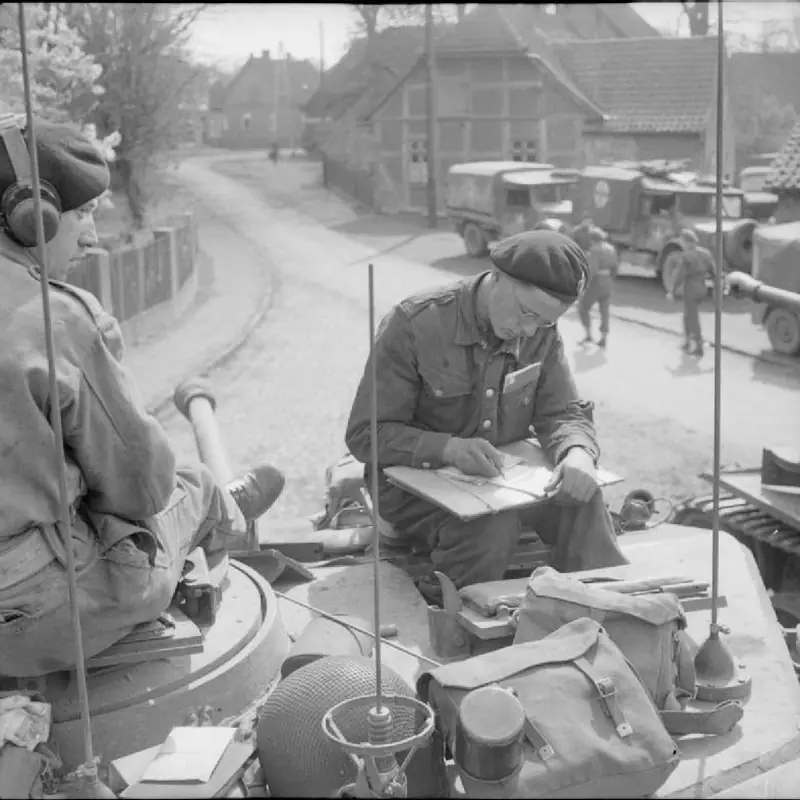

WW2 war diaries for British Army units are held at The National Archives in Kew, mostly in record series WO 165 to WO 179, arranged by theatre of war. Search the Discovery catalogue with the unit’s name and number and the year. Then view the diary free at Kew, buy a copy, or check whether it is on Ancestry. You need the right unit, usually a battalion, and dates.
Key facts
- What it is
- A daily record of a unit's events, often with signals and orders attached
- Where
- The National Archives, Kew, in WO 165 to WO 179 and a few other series
- Online
- An ongoing project is putting WW2 diaries on Ancestry (charges apply)
- You need
- The unit's name and number, and the dates
- Names
- Most diaries only name officers
Series and search advice from The National Archives' guide to British Army operations in the Second World War, checked 31 October 2026.
Every unit kept one. The National Archives says all units, from battalions to whole armies, kept a daily record of events, often with appendices of signals and orders.
What is a WW2 war diary?
A war diary is the unit’s official daily log, kept by its own officers. Expect:
- Place and date for each entry.
- Short summaries: moved, attacked, relieved, rested.
- Casualty figures, often with officers named.
- Appendices: orders, maps, signals, nominal rolls and awards.
It is about the unit, not the man. The National Archives warns that in most diaries only officers are mentioned by name. That is normal. Use his service record to put him in the unit, then use the diary to see what the unit did.
Which series is the war diary in?
Diaries are filed by theatre. Pick the series for where the unit was on your dates.
| Theatre or type | Series |
|---|---|
| War Office directorates | WO 165 |
| Home Forces (UK) | WO 166 |
| British Expeditionary Force (France, 1939 to 1940) | WO 167 |
| North-West Expeditionary Force (Norway) | WO 168 |
| Middle East forces | WO 169 |
| Central Mediterranean forces (Italy) | WO 170 |
| North-West Europe (1944 to 1945) | WO 171 |
| South-East Asia Command | WO 172 |
| West Africa forces | WO 173 |
| Madagascar | WO 174 |
| British North Africa forces | WO 175 |
| Various smaller theatres | WO 176 |
| Medical services | WO 177 |
| Military missions | WO 178 |
| Dominion forces | WO 179 |
| GHQ Liaison Regiment | WO 215 |
| Special services | WO 218 |
| Ships Signals sections | WO 257 |
| Royal Marine Commandos | DEFE 2 |
A unit that moved theatre moves series. A battalion in North Africa and then Italy may have diaries in WO 169, WO 175 and WO 170. Follow it.
How to search for a WW2 war diary
- Open Discovery’s advanced search. Restrict to department WO and the year or years.
- Enter the unit’s number and name. For example, “2 Bn” and the regiment.
- Try every format. The National Archives warns that units are catalogued with abbreviations (“Fd. Regt.” not “Field Regiment”) and inconsistently (“8th army” one time, “8 army” the next).
- Target a series if you know the theatre. Search within WO 170 for Italy, for instance.
- Note the reference. Something like WO 171/1234. You need it to order or view.
Catalogue entries usually cover a date range, often a year. One unit can have several files, so check each one’s dates.
Is it online?
Some are. The National Archives says an ongoing project is putting WW2 unit war diaries (1939 to 1946) online on Ancestry, searchable by name, unit and other details. Charges apply. Ancestry is free to use at Kew.
If it is not online, you can:
- Visit Kew and photograph it yourself, free, with a reader’s ticket.
- Order a copy from The National Archives for a fee. Get a price estimate first; diaries can be long.
- Hire a researcher to copy it. Many work at Kew.
How to read a war diary entry
Pages follow a grid: place, date, hour, summary of events, references to appendices. Read the summary column first.
Then:
- Decode the shorthand. Bn, Coy, Bde, FUP, LOB, RV. Our abbreviations glossary covers the common ones.
- Map the grid references. Entries often give map references rather than towns. The appendices sometimes include the maps.
- Read the appendices. Orders and nominal rolls can name more men than the main diary.
- Match his dates. Line up each posting date from his record. The day he was TOS the battalion, where was it?
Example (made up, for illustration)
This entry is invented to show the layout. It is not from a real diary.
| Place | Date | Hour | Summary of events | Refs |
|---|---|---|---|---|
| [Village name] | 14 | 0600 | Bn moved to FUP. A and B Coys attacked at 0730. Objective taken 1015. Casualties: 2 offrs, 14 ORs wounded. | App. C |
The man you are tracing may be one of those fourteen “ORs”. The diary will not say. His service record might, with a matching date and a wound entry.
When the war diary is missing or thin
Gaps happen. Diaries were lost, kept badly, or kept on the move. Try:
- The brigade and division diaries. Same events, higher view.
- Theatre headquarters papers. WO 205 for 21st Army Group, WO 201 for the Middle East, WO 203 for the Far East, WO 204 for Allied forces in North Africa, Italy and France.
- Orders of battle. The National Archives points to H F Joslen’s Orders of Battle, Second World War (HMSO, 1960) to place units.
- Official histories in CAB 106, CAB 101 and WO 277.
- The regimental museum. Many hold histories, journals and photographs.
Navy and RAF equivalents
- Royal Navy: ships kept logs (ADM 53), not war diaries. Operational reports and war history cases are in ADM 199. See Royal Navy WW2 service records.
- RAF: squadrons kept Operations Record Books in AIR 27. See RAF WW2 service records.
Next steps
No battalion yet? Read how to find which battalion grandad served in. Got one? Search Discovery tonight. Then write a one-page timeline: his dates from the record, the unit’s story from the diary.
FAQ: WW2 war diaries
Are WW2 war diaries free?
Viewing originals at Kew is free. Online copies on Ancestry need a subscription, though Ancestry is free to use inside The National Archives. You can also order copies from The National Archives for a fee.
Which series is my battalion's war diary in?
It depends on the theatre. North-west Europe is WO 171, Central Mediterranean (Italy) WO 170, Middle East WO 169, South-East Asia WO 172 and Home Forces WO 166. Search the unit across all War Office records if you are unsure.
Will my grandad be named in the war diary?
Probably not, unless he was an officer. The National Archives says most diaries only name officers. Some appendices list awards, casualties or reinforcements.
What if the war diary is missing?
Try the brigade and division diaries, which cover the same ground with less detail. Also check the theatre headquarters papers, such as WO 205 for 21st Army Group, and the regimental museum.
Do Royal Navy ships have war diaries?
Not in the Army sense. For ships, look at logs in ADM 53 and reports in ADM 199. See our Royal Navy records guide.
Can I find the diary entry for the day he was wounded?
Yes, if you know his battalion and the date. The daily British Army casualty lists (WO 417) give the date and type of casualty, and sometimes the battalion.
Sources
Checked 31 October 2026.
- The National Archives: British Army operations in the Second World War
- The National Archives: British Army soldiers in service after 1918
- The National Archives: Discovery catalogue
- The National Archives: Royal Navy operations in the Second World War
- Researching WW2 Soldiers: WW2 abbreviations and acronyms